Poker position strategy starts with the order of action: whose decision can you observe before making yours, and who can still respond afterwards? Acting later supplies more information, but it does not reveal anyone’s cards. In six-max no-limit Texas Hold’em (NLHE), position helps frame a decision alongside your hand, the pot, remaining stacks and previous actions.
Find the button, then follow the action
Position names describe seats relative to the dealer button. BTN means button; SB and BB are the small and big blinds. UTG, or under the gun, acts first before the flop at this six-player table. HJ means hijack, and CO means cutoff, the seat immediately before the button.
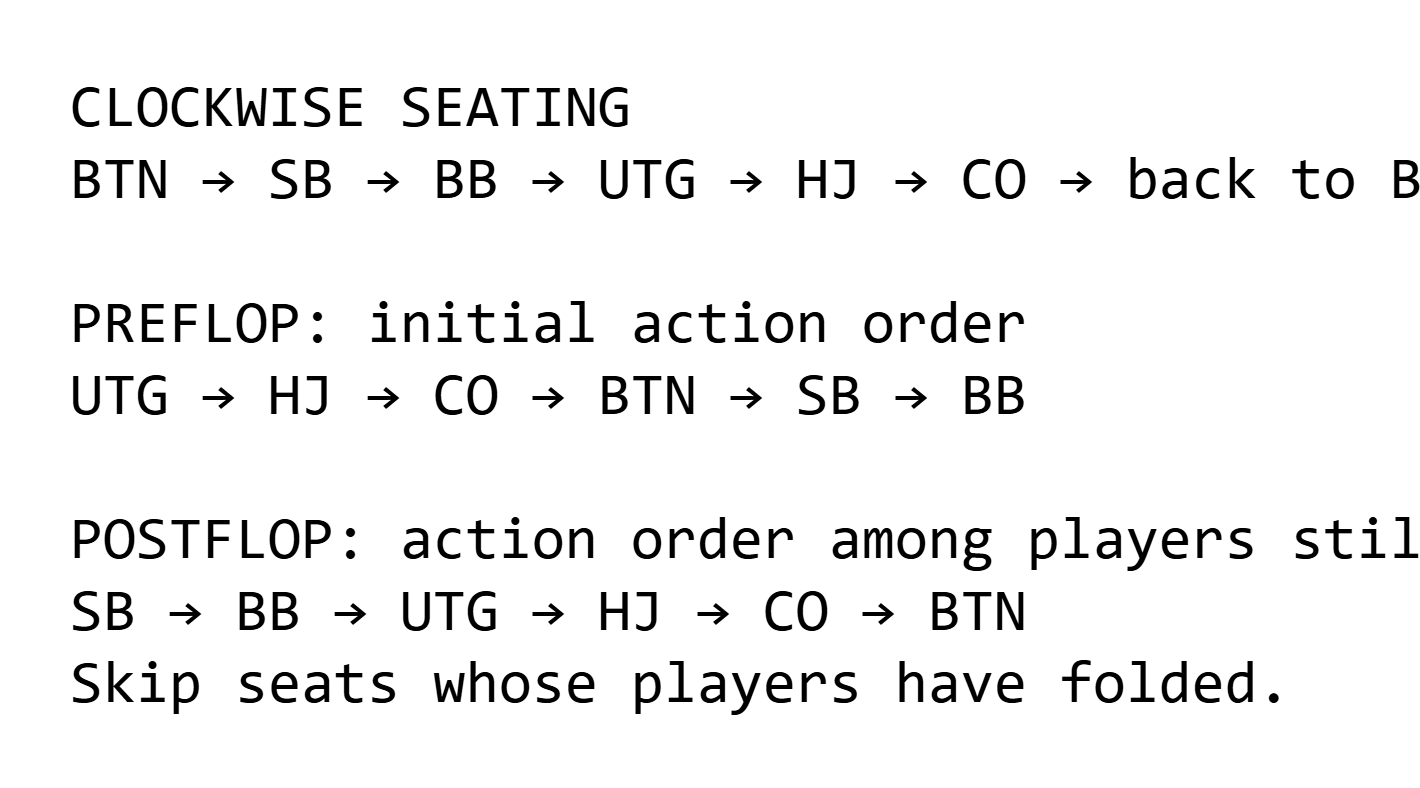
Preflop means before the first three community cards appear. Postflop covers the flop, turn and river betting rounds. Before the flop, action starts after the big blind. On later streets the first player still able to bet clockwise from the button acts first. A raise can require further responses, so these arrows describe the order, not a guarantee that everyone acts only once.
Heads-up play has an exception: with only two players dealt into the hand, the button posts the small blind and acts first preflop, then last postflop. Two survivors from a six-player deal retain their existing seats and blinds.
One complete hand, with the positions exchanged
This fictional comparison uses six players, a standard 52-card deck, demonstration blinds of 1/2 chips, starting stacks of 100 each and no rake. The same two players remain active in both versions: Hero holds Q♦ J♦, while Alex holds A♣ 8♣. Alex’s cards are disclosed here for reproducibility; Hero cannot see them during the hand.
Only their seats change. Hero occupies BTN in Case A and BB in Case B. The board and the actions taken by each position stay fixed. This is an illustration of decision order, not a recommended line.
| Stage | Case A: Hero on BTN | Case B: Hero in BB | Pot and remaining stacks |
|---|---|---|---|
| Blinds and folds | SB posts 1; Alex posts BB of 2. UTG, HJ and CO fold. | SB posts 1; Hero posts BB of 2. UTG, HJ and CO fold. | Pot 3. BTN has 100; BB has 98; SB has 99. |
| Preflop response | Hero raises to 5 total. SB folds. Alex adds 3 to call. | Alex raises to 5 total. SB folds. Hero adds 3 to call. | Pot 11. Hero and Alex each have 95. |
| Flop: Q♠ 8♥ 4♣ | Alex checks. Hero bets 4. Alex calls 4. | Hero checks. Alex bets 4. Hero calls 4. | Pot 19. Hero and Alex each have 91. |
| Turn: 2♠ | Alex checks; Hero checks. | Hero checks; Alex checks. | Pot 19; both stacks remain 91. |
| River: K♥ | Alex checks; Hero checks. | Hero checks; Alex checks. | Pot 19; both stacks remain 91. |
| Showdown | Hero’s pair of queens beats Alex’s pair of eights using the strongest five-card hands. Hero receives the 19-chip pot. | Hero finishes with 110; Alex with 91. SB retains 99. | |
The flop pot is 11: five chips from BTN, five from BB and the folded small blind’s one. Both active players have 95 remaining. Their effective stack—the smaller remaining stack—is therefore 95 going into the flop.
What changes before Hero chooses?
In Case A, Hero sees Alex check before choosing whether to check or bet. That observation adds information, but does not establish weakness. Alex could hold a strong hand and still check. If Hero bets, Alex can fold, call or raise.
In Case B, Hero makes the first flop choice without observing Alex’s action on that street. After checking and facing the four-chip bet, Hero gets another decision, now informed by that bet. Hero holds the same cards in either seat. The sequence of available information has changed.
The shared showdown result does not prove that either flop decision was best. The example fixes the later cards and responses to isolate action order. During play, those future events remain unknown.
Separate the seat label from the live situation
An absolute seat number identifies a chair. Its poker position changes as the button moves. Relative position describes where you act compared with the opponents still involved. The cutoff acts before an active button postflop. If the button folds, the cutoff may become last.
In a multiway pot, a player in the middle sees earlier actions while still having players behind. A check ahead therefore supplies only part of the picture. Preflop decisions also need this distinction: BB acts last on the initial pass, yet usually acts early after the flop.
At a decision, identify who has acted, who remains behind, the price of calling and the effective stacks. Position also affects bluffing in poker because later responses remain uncertain. GTO models can examine these interactions under specified assumptions, but a seat label alone cannot determine an action.