
Before the flop, the first eligible player clockwise from the big blind acts first. On the flop, turn and river, the first eligible player clockwise from the dealer button acts first. In heads-up Hold’em, the button posts the small blind and acts first preflop. The big blind acts first on every later street, provided betting remains possible.
Find the starting seat for the street
The button, usually marked BTN, identifies the dealer position. The small blind (SB) and big blind (BB) are forced contributions posted before the cards are dealt. Their positions provide the reference points for deciding where action begins.
A street is a betting round. Preflop comes before any community cards appear. The flop introduces three community cards, followed by one on the turn and one on the river.
“Acts first” does not necessarily mean “puts in the first voluntary bet”. A player might check when no bet is outstanding, or respond to an existing wager. Posting a blind is a forced contribution, so the big blind’s posting does not make that player the first to act preflop.
These rules describe ordinary no-limit Texas Hold’em with no live straddles. A live straddle is an additional blind wager that can alter preflop action under the applicable house rules.
Two illustrative seat maps and an action tree
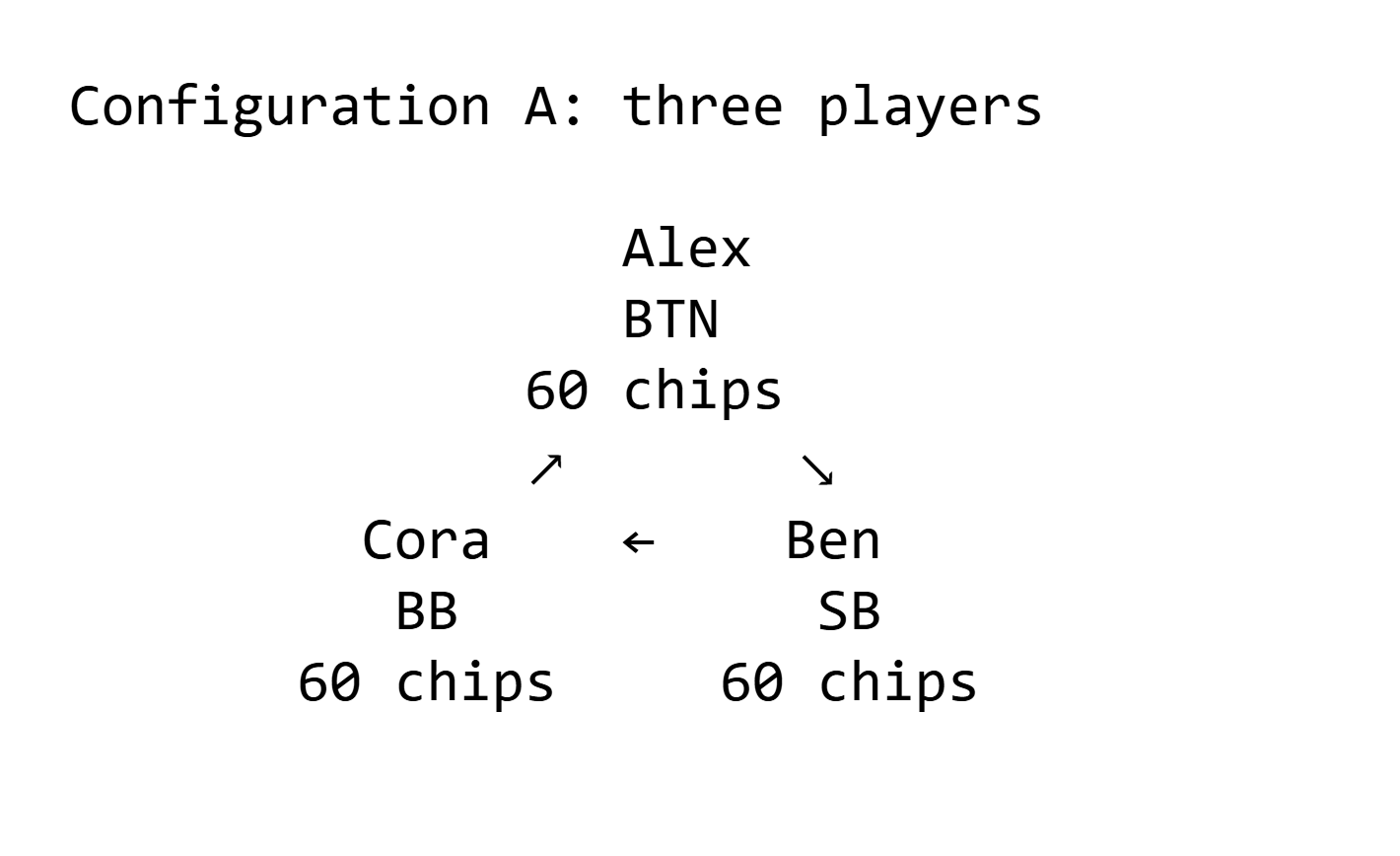
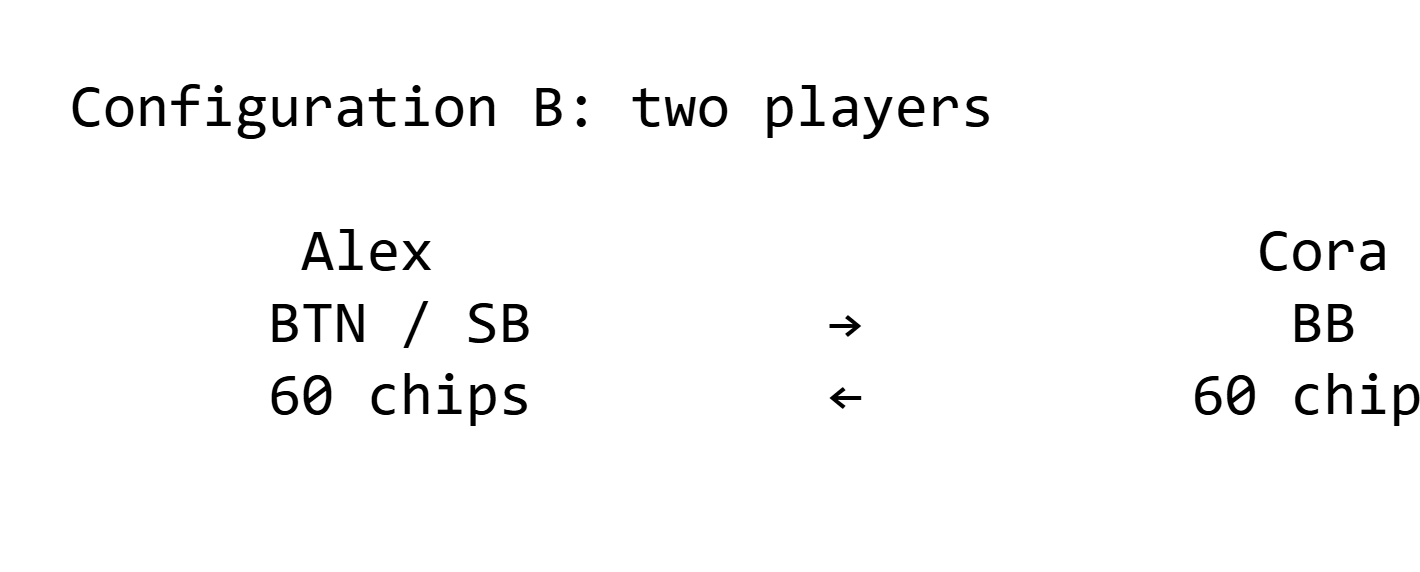
Both configurations below use a standard 52-card pack, blinds of 1/2 chips, standard starting stacks of 60 chips per player before posting, and no rake. The all-in branch below gives Ben a shorter stack. They are invented teaching examples. The heads-up configuration is a separate setup with fresh starting stacks.
| Street | A: three-handed | B: heads-up |
|---|---|---|
| Preflop | Alex, on the button | Alex, on the button and small blind |
| Flop | Ben, in the small blind | Cora, in the big blind |
| Turn | Ben, in the small blind | Cora, in the big blind |
| River | Ben, in the small blind | Cora, in the big blind |
Configuration A: three-handed action tree
Ben posts 1 and has 59 chips behind. Cora posts 2 and has 58 behind. Alex has posted neither blind and still has 60. Alex acts first because Alex is the next seat clockwise from the big blind.
- All three reach the flop with chips: Alex calls 2, Ben adds 1 to call, and Cora checks. Each has 58 chips behind and the pot contains 6. Ben acts first on the flop because Ben is the first eligible player clockwise from the button. Action then proceeds to Cora and Alex.
- Ben folds preflop: Alex calls 2, Ben folds, and Cora checks. Alex and Cora each have 58 behind. Ben’s posted chip remains in the 5-chip pot. Cora acts first on the flop because Ben’s folded seat is skipped. Alex retains the button.
- Short-stack variation: Ben starts with 15 chips and Alex and Cora start with 60 each. If all three reach the flop having paid two each, Ben has 13 left. Ben opens the flop all-in for 13 and both opponents call. Now the pot becomes 45, and Alex and Cora each have 45 chips left. On the turn Cora acts first and Alex follows.
The turn and river use the same starting rule as the flop. Ben starts each if still eligible. If Ben has folded or is all-in, Cora starts if eligible. The previous street’s first bettor or last raiser does not set the next street’s starting seat.
Configuration B: heads-up action tree
Alex now holds both the button and the small blind. After posting 1, Alex has 59 chips behind. Cora posts the big blind of 2 and has 58 behind.
- Preflop: Alex acts first. For an illustrative continuation, Alex adds 1 to call and Cora checks. Both then have 58 chips behind, with 4 in the pot.
- Flop, turn and river: Cora acts first on each street while both players remain eligible. Alex follows Cora.
- A player folds or further betting becomes impossible: there is no later betting round requiring a first actor.
This is the key heads-up change: Alex’s button position acts first before the flop and second after it.
Skip folded and all-in players
Follow the seats clockwise, skipping anyone who has folded or has no chips left to act with. A fold removes a player from the hand. An all-in player remains involved in the pot but takes no further betting actions.
An opponent may still need to respond to an all-in wager. However, if everyone remaining is all-in, or only one player has chips and no call is outstanding, no further betting action is available. Do not assign a first bettor simply because community cards remain to be dealt.
Acting first and showing first are separate rules
Betting order determines whose decision comes next during a street. It does not, by itself, determine who must expose cards first at showdown. Showing order depends on the applicable showdown rules and how the final action ended. Use the street and seat positions above to identify the first betting action.